
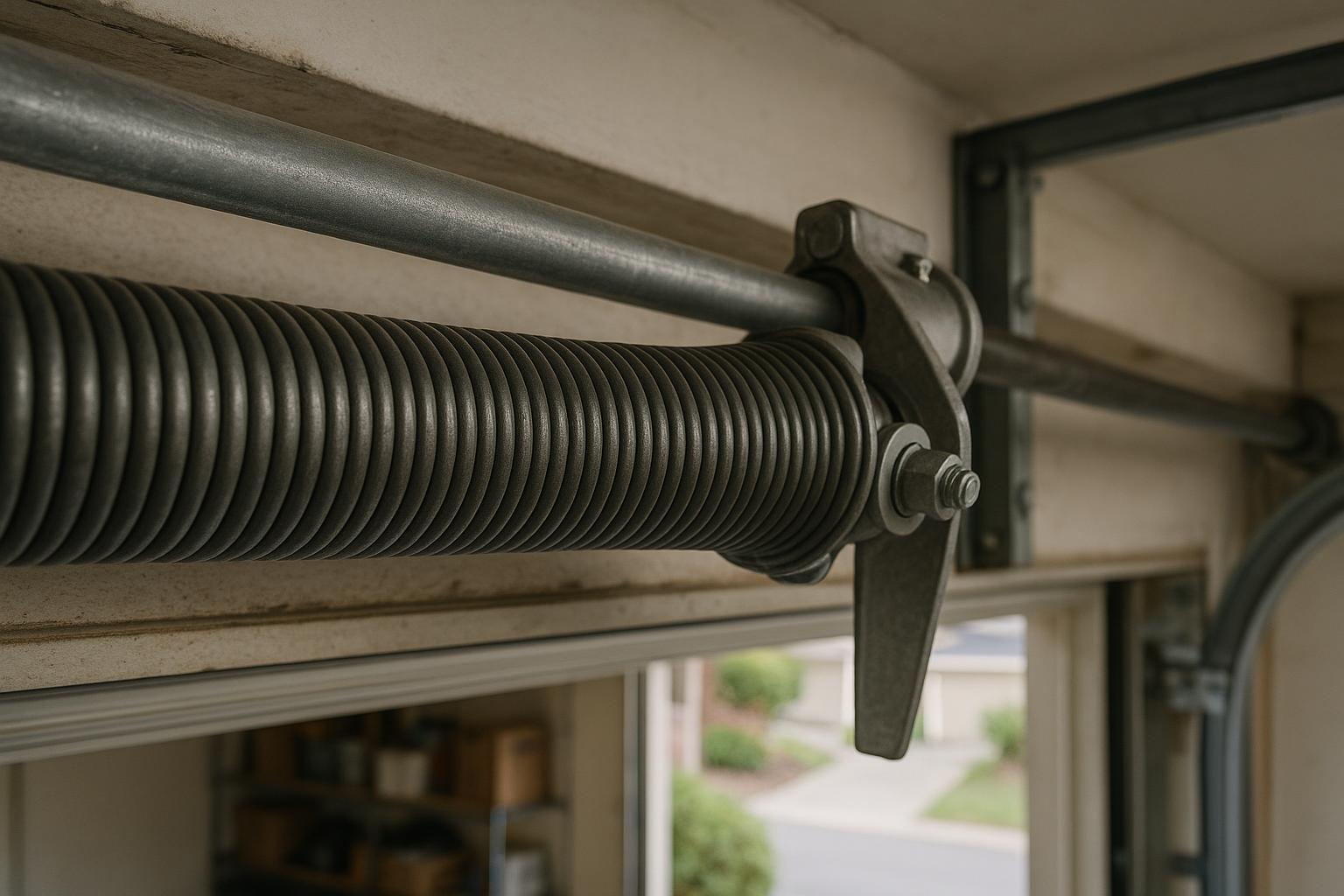
Your Garage Door Springs Are Trying to Tell You Something
If you've ever heard a garage door spring snap, you know it's not subtle. It sounds like a gunshot echoing through the house, and it leaves your garage door completely inoperable — usually at the worst possible time. The good news is that garage door springs almost always show warning signs before they fail. Knowing what to look for can save you from an emergency repair, potential injury, and the inconvenience of a door that won't budge.
Here in La Jolla, where many homes have two- and three-car garages that see daily use, worn springs are one of the most common service calls we handle. Let's walk through the warning signs so you can catch the problem early.
How Garage Door Springs Work
Before we get into the warning signs, it helps to understand what your springs actually do. Your garage door is heavy — most residential doors weigh between 130 and 350 pounds. The springs carry almost all of that weight, making it possible for your opener to lift the door with a relatively small motor.
There are two main types of garage door springs:
- Torsion springs — Mounted on a metal shaft above the door opening. These twist to store energy and are the most common type in modern homes.
- Extension springs — Mounted along the horizontal tracks on either side of the door. These stretch and contract to counterbalance the door's weight.
Both types are under extreme tension, which is why spring replacement should always be handled by a professional. But spotting the warning signs? That's something every homeowner can and should do.
7 Warning Signs Your Garage Door Springs Are Failing
1. The Door Feels Heavier Than Usual
Try this simple test: disconnect your garage door opener by pulling the emergency release cord, then manually lift the door. A properly balanced door with healthy springs should lift smoothly and feel relatively light. If it feels noticeably heavy or you're straining to get it open, your springs are losing tension and nearing the end of their life.
2. The Door Opens Unevenly or Crooked
If one side of your garage door rises faster than the other, it usually means one spring has weakened more than its counterpart. This is especially common with extension spring systems where each side operates somewhat independently. A crooked door puts stress on the tracks, rollers, and opener, so addressing it early prevents a cascade of other problems.
3. You Hear Squealing, Grinding, or Popping Sounds
Some noise during operation is normal, but new or worsening sounds are a red flag. Squealing or grinding can indicate that a spring is binding or that the coils are rubbing against each other unevenly. A loud pop or bang while the door is stationary could mean a spring has already partially separated.
4. Visible Gaps in the Spring Coils
This is one of the easiest signs to spot. Take a look at your torsion spring above the door. A healthy spring has tightly wound coils with uniform spacing. If you see a visible gap — a section where the coils have separated — the spring is either broken or about to break. Do not attempt to operate the door if you see this.
5. The Door Slams Shut or Won't Stay Open
When you open your garage door manually and release it at the halfway point, it should stay roughly in place. If it slides down or slams shut, the springs no longer have enough tension to counterbalance the door's weight. This is a safety hazard, especially in homes with children or pets.
6. Your Opener Is Struggling
Is your garage door opener straining, moving slower than usual, or stopping partway through the cycle? Before you blame the opener, consider the springs. When springs weaken, the opener has to work much harder to lift the door. Over time, this extra strain can burn out the opener motor entirely — turning a spring replacement into a much more expensive repair.
7. Your Springs Are More Than 7-10 Years Old
Most standard garage door springs are rated for approximately 10,000 cycles. One cycle equals one open-and-close sequence. For a household that opens and closes the garage door four times a day, that works out to roughly seven years. If your springs are approaching or past that age, they're living on borrowed time — even if they look fine from the outside.
Why You Shouldn't Wait for Springs to Snap
It's tempting to take the "if it ain't broke, don't fix it" approach, but with garage door springs, waiting for a complete failure comes with real risks:
- Safety hazard: A snapping spring releases an enormous amount of stored energy. While modern safety cables help contain extension springs, the force involved can still cause injury or property damage.
- You'll be stuck: A broken spring means your garage door won't open. If your car is inside, you're not going anywhere until the spring is replaced.
- Damage to other components: A failing spring puts extra stress on your opener, cables, drums, and tracks. Replacing springs proactively is far cheaper than replacing springs plus an opener plus bent tracks.
- Emergency pricing: A planned spring replacement during normal business hours is significantly less expensive than an emergency weekend call when you're stranded.
What Professional Spring Replacement Looks Like
When our team handles a spring replacement in La Jolla or the surrounding communities like Del Mar, Pacific Beach, or University City, the process typically takes about an hour and includes:
- Inspecting the entire spring system and identifying the correct spring size and type for your door
- Safely releasing the tension on the old springs and removing them
- Installing new springs rated for your door's specific weight and size
- Balancing the door so it opens and closes evenly
- Lubricating all moving parts and testing the full system, including the opener's safety features
We always recommend replacing both springs at the same time, even if only one has failed. If one spring has reached the end of its lifespan, the other is almost certainly close behind. Replacing both saves you from paying for a second service call a few weeks or months later.
A Quick Monthly Check Can Save You Hundreds
You don't need to be a garage door expert to keep an eye on your springs. Once a month, take 60 seconds to:
- Visually inspect your springs for gaps, rust, or deformation
- Listen for unusual sounds during operation
- Watch the door open and close to make sure it moves evenly
- Test the balance by disconnecting the opener and lifting the door manually
If anything seems off, call a professional before the problem gets worse. At La Jolla Garage Door, we offer honest assessments and straightforward pricing — no pressure, no upselling. Whether you're in Clairemont, Solana Beach, or right here in La Jolla, we're happy to take a look and let you know exactly where your springs stand.
Catching a failing spring early is one of the simplest ways to avoid an expensive, inconvenient, and potentially dangerous garage door emergency. Your springs are working hard every single day — give them a glance once in a while, and they'll give you plenty of warning before they call it quits.